It represents the power saving mode of the robot. More...
#include <RoboticLine.h>
 Collaboration diagram for RobotPowerMode: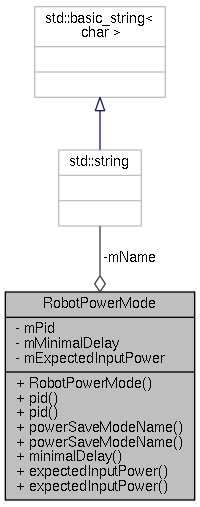
Public Member Functions | |
| RobotPowerMode (const uint32_t &pid, const double &delay) | |
| It constructs the robot's power saving mode. More... | |
| uint32_t | pid () const |
| void | pid (const uint32_t &pid) |
| void | powerSaveModeName (const std::string &name) |
| std::string | powerSaveModeName () const |
| double | minimalDelay () const |
| double | expectedInputPower () const |
| void | expectedInputPower (const double &expectedInputPower) |
Private Attributes | |
| uint32_t | mPid |
| Identification of the robot power saving mode, unique for the robot. | |
| std::string | mName |
| The name of the power saving mode, e.g. "motors", "brakes", etc. | |
| double | mMinimalDelay |
| The minimal time in seconds which is required for the stationary robot to apply this power saving mode. | |
| double | mExpectedInputPower |
| Expected input power of the robot if it is not dependent on the robot configuration (joint values), otherwise -1. | |
Detailed Description
It represents the power saving mode of the robot.
The class represents the power saving mode of the robot, which can be applied if the robot is in a stationary position. For example, the stationary robot can usually be held by electric motors (dummy power saving mode) or brakes. However, even deeper power saving modes such as bus-power-off and hibernate are possible for e.g. KUKA robots.
Definition at line 107 of file RoboticLine.h.
Constructor & Destructor Documentation
|
inline |
It constructs the robot's power saving mode.
- Parameters
-
pid Identification of the power saving mode. delay The power saving mode is possible to apply if the robot is at least delay seconds in a stationary position.
- Note
- If mExpectedInputPower is equal to -1, then the input power is dependent on the robot configuration, i.e. position.
Definition at line 115 of file RoboticLine.h.
The documentation for this class was generated from the following file:
- /home/bukatlib/Downloads/GeneratorEquationsAsImages/inc/RoboticLine.h